
Body armor is a critical piece of safety equipment that has saved thousands of people’s lives. Threat level, heat accumulation, comfort, mobility concealability, and affordability are the key variables to consider while determining which solution will best fit ones needs. When it comes to body armor, the threat level or protection level is usually the most important factor to consider, as well as the most difficult to comprehend.
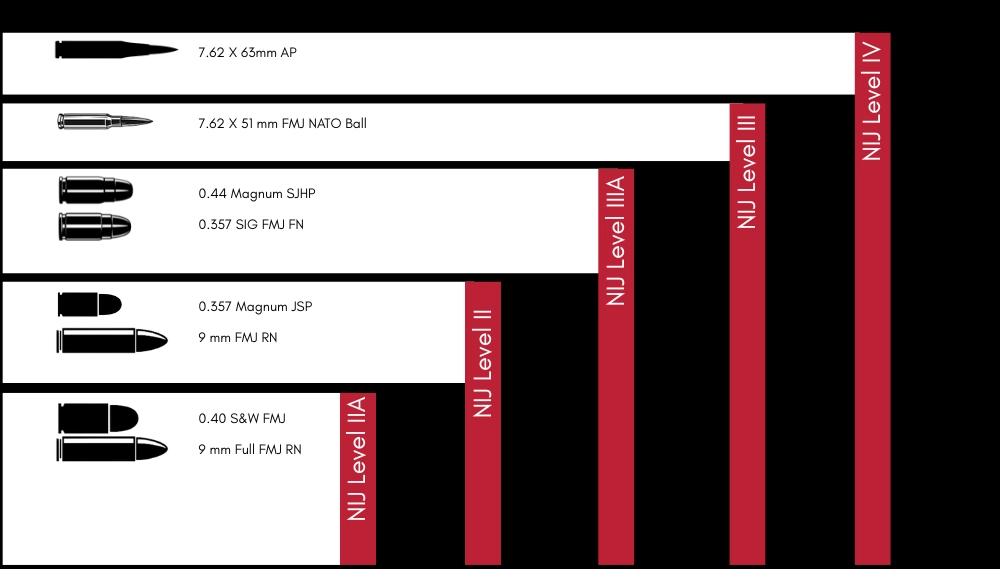
The National Institute of Justice (NIJ) in the U.S. has established and updated minimum performance standards for body armor to guarantee that users understand what their body armor will protect them from. There are 5 threat levels for which body armor is categorized under NIJ: Level IIA, Level II, Level IIIA, Level III and Level IV.
Armor is generally soft body armor made up of layers of high-strength woven fibres. Aramid fibres like Kevlar, Twaron, and Goldflex are common examples, as are polyethylene fibers like Spectra and Dyneema.
New and unworn Type IIA armor must be designed and tested to stop:
9 mm Full FMJ RN bullets with a specified mass of 8.0 g and a velocity of 373 m/s ± 9.1 m/s
.40 S&W FMJ bullet with a weight of 11.7 g and a velocity of 352 m/s ± 9.1 m/s
A Conditioned Type IIA armor must be tested using:
9 mm FMJ RN bullets with a specified load of 8.0 g and a velocity of 355 m/s ± 9.1 m/s.
.40 S&W FMJ bullets with a weight of 11.7 g and a velocity of 325 m/s ± 9.1 m/s
LEVEL II OR TYPE II BODY ARMOR IS A STEP UP FROM LEVEL IIA AND IS MOST OFTEN A SOFT BODY ARMOR.
New and unworn Type II armor are designed and tested to stop:
9 mm FMJ RN rounds with a mass of 8.0 g and a velocity of 398 m/s 9.1 m/s
.357 Magnum Jacketed Soft Point rounds with a stated mass of 10.2 g and a velocity of 436 m/s 9.1 m/s.
TYPE II ARMOR THAT HAS BEEN CONDITIONED MUST BE TESTED WITH:
9 mm FMJ RN rounds with a weight of 8.0 g and at a velocity of 379 m/s 9.1 m/s
357 Magnum JSP rounds with a stated mass of 10.2 g and a velocity of 408 m/s 9.1 m/s
Level II body armor, like IIA, is often lightweight, comfortable, and convenient to conceal, but it provides far greater protection against blunt force trauma which is caused by the round’s kinetic energy striking the plate or vest. Because of this, most concealable body armor vests are either Level II or Level IIIA, and Level IIA is now becoming more obsolete.
The new NIJ Level IIIA body armor protects against the following:
.357 SIG FMJ Flat Nose (FN) rounds with a mass of 8.1 g at a velocity of 448 m/s ± 9.1 m/s.
.44 Magnum Semi Jacketed Hollow Point (SJHP) rounds with a stated mass of 15.6 g at a velocity of 436 m/s ± 9.1 m/s.
Conditioned armors are designed and tested against:
.357 SIG FMJ FN rounds weighing 8.1 g and travelling at a velocity of 430 m/s ± 9.1 m/s.
6 g (240 gr) .44 Magnum Semi Jacketed Hollow Point (SJHP) bullets at a velocity of .44 Magnum SJHP rounds with a mass of 15.6 g and a velocity of 408 m/s ± 9.1 m/s
It also protects against the majority of handgun threats, as well as the threats listed in Types IIA, and II.
Level IIIA, like Level IIA and Level II, is most often soft armor, however hard armor plates and ballistic shields can also be found with a level IIIA rating.
Level III marks the shift from soft body armor vests to ballistic plate.
Type III hard armor or plate inserts must be tested with 7.62 mm FMJ steel jacketed bullets (US Military designation M80) with a specific mass of 9.6 g and a velocity of 847 m/s ± 9.1 m/s.
Despite the fact that the NIJ does not recognize Level III+ rating, heavy armor rifle plates of Level III+ are available in the industry. These plates are generally marked with a + to signify that they stop the same rounds at greater velocity or to defend against NIJ threat category III as well as other threats such as M855 and M193.
NIJ Level III and III+ body armor plates are available at a variety of price points, depending on the weight and composition of the rifle plate. Hard armors and plate inserts that have been authorized by the NIJ must be clearly identified as providing ballistic protection only when worn in conjunction with the NIJ-approved flexible armor system with which they were tested.
Under NIJ 0101.06 standards, Level IV ballistic plates are the highest-rated hard armor plates. These hard armor plates were made to withstand a single hit from an armor-piercing rifle. These rifle plates have been tested to stop 7.62MM armor-piercing (AP) rounds moving at 2880 ft/s.
Since level IV ballistic plates are only tested to stop one shot, but a level III hard armor plate is tested to stop 6 bullets, a level IV hard armor plate is not necessarily better than a level III hard armor plate.